The architecture of surfaces: between rhythm, matter, and new design visions
There is a moment, when facing certain materials, where the eye stops understanding. Not out of confusion, but because the surface is doing something unexpected. It is from that feeling that Mirage’s proposal for Fuorisalone 2026 begins.
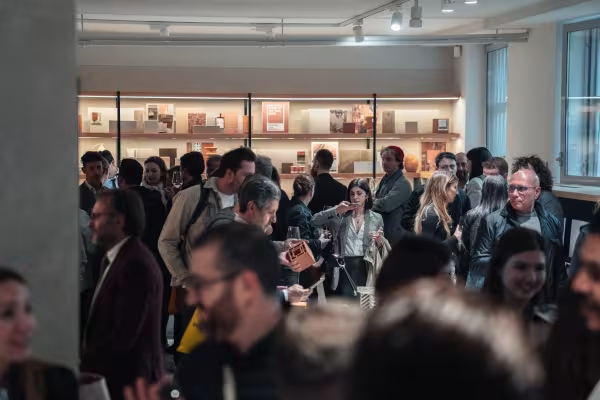
From April 20 to 26, the Mirage Project Point in Milan hosts the presentation of SHIKI—the new Atelier Mirage collection designed with Studio Hasuike—and the exhibition of the finalist projects from Mirage Thread, the Trans-American Design Challenge involving architects and designers from Costa Rica, Puerto Rico, and Mexico. With the presence of Giulio Cappellini, the space becomes a place for open dialogue: between those who produce, those who design, and those who imagine the future of ceramic surfaces.
From April 20 to 26, the Mirage Project Point in Milan hosts the presentation of SHIKI—the new Atelier Mirage collection designed with Studio Hasuike—and the exhibition of the finalist projects from Mirage Thread, the Trans-American Design Challenge involving architects and designers from Costa Rica, Puerto Rico, and Mexico. With the presence of Giulio Cappellini, the space becomes a place for open dialogue: between those who produce, those who design, and those who imagine the future of ceramic surfaces.
SHIKI. Thought before product
“The value does not lie in the single slab. It is born from the composition.”

Makio e Naomi Hasuike
Makio Hasuike has spent over sixty years understanding how objects speak to people. Awarded the Compasso d'Oro for Lifetime Achievement, he is one of the most influential voices in Italian industrial design. Naomi Hasuike, an architect, brings a sensitivity to the collaboration that blends precision with a global vision. When these two names meet porcelain stoneware, the result is not just a surface. It is a system. SHIKI starts from the tatami. Not as a quote, nor as a decorative tribute. For centuries, the tatami has been the unit of measurement for Japanese domestic space: a module that generates rhythm, proportion, and harmony. In SHIKI, that principle becomes a compositional grammar.

SHIKI
The collection is a complex set of modules, rhythms, and directions that the designer arranges according to their own logic, generating radically different environments—from absolute continuity to controlled tension between opposing visual fields. The surface stems from a process involving weft, warp, and resist-glaze techniques that recreate the perception of woven fiber while remaining, in substance, porcelain stoneware. This short-circuit is intentional. The eye reads a fabric, while the hand discovers ceramics. The border present in one of the two variants is not an ornament, but a structural element: it marks the direction, strengthens the visual module, and introduces that subtle vibration characteristic of natural materials. The four shades of SHIKI do not have color names. They are called Brezza, Vapore, Ripa, and Alba. They are conditions of light, memories of nature, atmospheric states. Strips and squares in Texture Tatami or Grafite add a second compositional level, calibrated by the designer with the precision of someone composing a visual score.
Contest Mirage Thread
Nine voices, one material

Mirage Thread
If SHIKI speaks the language of measure and systems, Mirage Thread responds with that of freedom and disruption. The contest was born with a precise but intentionally open goal. Architects and interior designers were invited to take Mirage porcelain stoneware surfaces and transform them into something unexpected: a piece of furniture, an interior design element, a form capable of surprising. Among the participants selected for the final, nine come from Latin America and the Caribbean: Costa Rica, Puerto Rico, Mexico. Different backgrounds, different approaches, a single starting material. What unites their projects is not style, but attitude. A genuine curiosity toward the limits of ceramics and the desire to push them further. Their works are exhibited in a dedicated space within the Mirage Project Point. Visiting them means understanding the potential of porcelain stoneware when it stops being just a surface.
Via Marsala, 7, 20121 Milano | Dal 20 al 26 aprile 2026
Visit us